Sasara Wasana Thuru Lyrics
by Amaradeva
“sasara vasana thuru” (සසර වසන තුරු), Sasara Wasana Thuru (සසර වසන තුරු) lyrics: a Sinhala Buddhist devotional song sung by Amaradeva, presented here in Sinhala script, Singlish transliteration, English translation and the meaning explained and also listed under Patriotic. Many know it simply as sasara vasana, and in Sinhala it is සසර වසන තුරු ගී පද.
| SONG | Sasara Wasana Thuru |
|---|---|
| SINGER | Amaradeva |
| CATEGORY | Buddhist Devotional, Patriotic |
| VIEWS | 1,071 |
| UPDATED |
Sasara Wasana Thuru Lyrics Singlish
(sasara vasana thuru
niwan dakina thuru...//)
pin ketha hela ran derane
yali upadinata
hetu vasana wewa
hetu vasana

(rathnamali sae kiranayi maha bo sewaniyi
thisa wewayi seegiriyayi mage urumayi...//)

(sasara vasana thuru
niwan dakina thuru...//)
pin ketha hela ran derane
yali upadinata
hetu vasana wewa
hetu vasana
සසර වසන තුරු ගී පද
(සසර වසන තුරු
නිවන් දකින තුරු...//)
පින් කෙත හෙළ රන් දෙරණේ
යළි උපදින්නට
හේතු වාසනා වේවා
හේතු වාසනා

(රත්නමාලි සෑ කිරණයි මහ බෝ සෙවණයි
තිසා වැවයි සීගිරියයි මගේ උරුමයයි...//)

(සසර වසන තුරු
නිවන් දකින තුරු...//)
පින් කෙත හෙළ රන් දෙරණේ
යළි උපදින්නට
හේතු වාසනා වේවා
හේතු වාසනා
Sasara Wasana Thuru Lyrics English Translation
(For as long as I wander through saṃsāra (the cycle of rebirth),
until the day I see nibbāna (liberation)…)
In this field of merit, this golden Sinhala soil,
to be born here again,
may the causes and the good fortune fall in place,
the causes and the good fortune.
(The rays of the Ruwanmali stupa, the shade of the great Bodhi tree,
the Tissa reservoir and Sigiriya, these are my inheritance…)
(For as long as I wander through saṃsāra (the cycle of rebirth),
until the day I see nibbāna (liberation)…)
In this field of merit, this golden Sinhala soil,
to be born here again,
may the causes and the good fortune fall in place,
the causes and the good fortune.
English translation by the Lyrics LK editorial team and community contributors, many of them native Sinhala speakers. Translations are interpretive and may not capture every nuance of the original Sinhala. Anyone can register to submit a translation, suggest a correction to this one, or add a song that is missing.
Sasara Wasana Thuru Song Meaning and Interpretation
This is a love song to a homeland, sung as a quiet prayer. The voice belongs to a Sri Lankan who looks at his own land, the temples and tanks and rock fortresses he grew up among, and makes one wish: that for as long as he is bound to be reborn at all, every one of those births might happen here, on this same Sinhala soil, until the day he finally reaches nibbāna and the wandering stops.
To understand why that wish carries so much weight, you have to hear the Buddhist idea underneath it. Saṃsāra is the long, repeating cycle of birth and death that, in Buddhist thought, every being is caught in. Nobody chooses where they are born next; that is shaped by kamma and by hetu and vāsanā, the causes and the accumulated good fortune you carry from life to life. So when the song asks “may the causes and the good fortune fall in place,” it is not a casual hope. It is asking that all of that unseen machinery line up so that rebirth keeps landing in this one place he loves. He calls the land a pin keth, literally a “field of merit,” the image of soil where good deeds grow like a crop, and ran derana, golden earth, the way you’d speak of something precious and blessed.
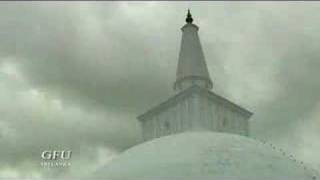
The middle verse is the heart of it, and it is where a listener from outside Sri Lanka needs a little decoding. He names four things as his urumaya, his inheritance, the things he feels he belongs to. Ruwanmali (the Ruwanwelisaya in Anuradhapura) is one of the most sacred Buddhist stupas on the island, its white dome a symbol of devotion for centuries. The maha bo, the great Bodhi tree, is the sacred fig at Anuradhapura grown from a cutting of the very tree the Buddha sat under, the oldest historically recorded tree in the world. Tissa Wewa is an ancient reservoir from the same old kingdom, standing for the wisdom of a civilization that mastered water and farming long ago. And Sigiriya is the fifth-century rock fortress and its frescoes, the height of the island’s art and engineering. Set side by side, these four are shorthand for the whole sweep of Sinhala Buddhist heritage: faith, history, ingenuity, and beauty.
What the song leaves you holding is a deep, calm belonging. There is no romance and no grief in it, only the contentment of someone who has found the place his soul is at home and would not trade it across a hundred lifetimes. Coming from Amaradeva’s voice, it lands as something close to a national hymn, a gentle vow that this land and its inheritance are worth being born for, again and again, until there is no more being born at all.
Meaning written by the Lyrics LK editorial team and community contributors. It reflects our reading of the song and may differ from the artist's intent. Anyone can register to submit their own meaning, suggest a correction to this one, or add a song that is missing.
Performances of Sasara Wasana Thuru
Cover versions, live performances, and reality-show contestant performances of “Sasara Wasana Thuru” on YouTube.
Reality Show Performances · 6
 ▶▶
▶▶ ▶
▶ ▶▶
▶▶ ▶
▶Live Performances · 1

Cover Versions · 12
 ▶
▶ ▶
▶ ▶
▶ ▶
▶ ▶
▶ ▶
▶ ▶
▶ ▶
▶ ▶
▶ ▶
▶ ▶
▶ ▶
▶Performance videos are hosted on YouTube by their respective creators. Links open on YouTube.